Dating Business Cycles

The Euro Area Business Cycle Dating Committee (EABCDC) was founded in 2003 by CEPR under the initiative of Lucrezia Reichlin to establish the chronology of recessions and expansions of the eleven-original euro-area member countries plus Greece for 1970-1998, and of the entire euro area from 1999 onwards.

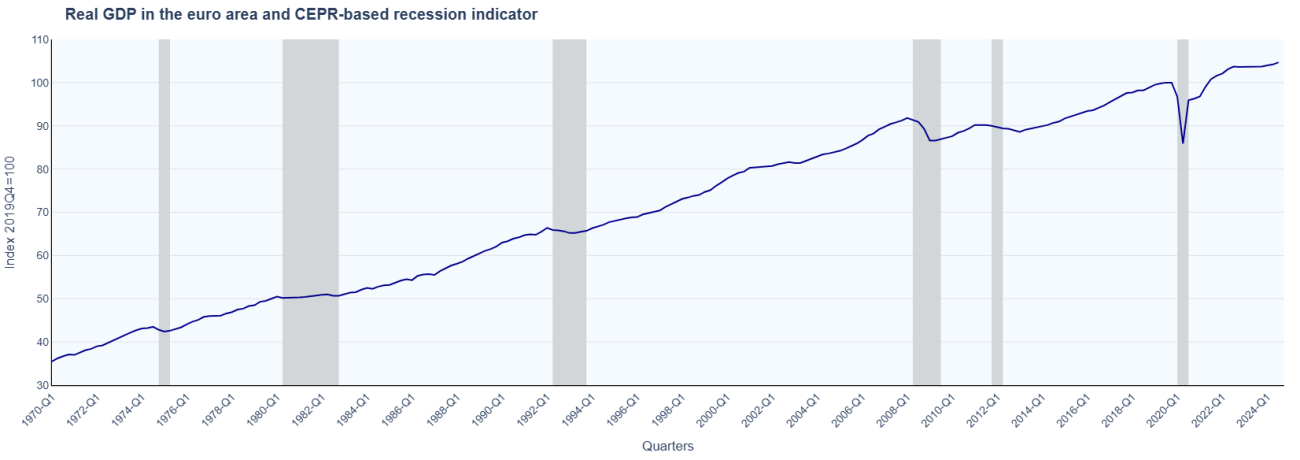
GDP graph preview

Euro Area Economic Insights

Discover detailed graphs depicting GDP growth and unemployment rates in the Euro Area, complemented by CEPR-based recession indicators. These interactive visualizations provide a comprehensive view of economic cycles and trends.
Latest Committee announcements

Fall 2025 statement of the Dating Committee on the current state of the economic activity in the euro area.

The CEPR-EABCN Euro Area Business Cycle Dating Committee convened on September 12, 2025, to assess the current state of economic activity in the euro area, using quarterly data through the second quarter of 2025 and monthly data through July 2025. Year-on-year real GDP growth has picked up over the past year but remains modest. Employment continued to expand, though at a slowing pace. The euro area’s unemployment rate matched its historic low of 6.2% in July 2025.

Cycles Image

Dating activities and bi-annual statements on the state of euro area economic activity are conducted in total independence of EABCN. Research initiatives launched pursued by the Committee are subject to the approval and evaluation of the EABCN Scientific Committee.

Members

The Euro Area Business Cycle Dating Committee is composed of five CEPR researchers. The chair of the Committee is named by the President of CEPR and the chair of the EABCN Scientific Committee, while remaining members are chosen by the President of CEPR, the chair of the Euro Area Business Cycle Dating Committee, and the chair and vice-chair of the EABCN Scientific Committee.

Mr. Frank Smets

Director General of the Directorate General Research

Frank Smets is Deputy Head of the Monetary and Economic Department of the Bank for International Settlements. Previously he was Adviser to the Executive Board, Director General Economics, Adviser to the President and Director General Research at the European Central Bank.

He is a part-time professor of economics at University of Ghent. He is a Research Fellow of the Centre for… (read more...)

Professor Benjamin Born

Benjamin Born is Professor of Macroeconomics at the University of Bonn and Research Director at the ifo Institute. He is a Research Fellow at CEPR and CESifo, advises the European Commission’s DG ECFIN, serves on the European Parliament’s Expert Group on Monetary Policy, and sits on the CEPR–EABCN Euro Area Business Cycle Dating Committee. He is on the editorial boards of the Journal of Monetary… (read more...)

Professor Evi Pappa

Professor Evi Pappa is a Full Professor of Economics at Universidad Carlos III de Madrid, with a distinguished academic background and a Ph.D. from Universitat Pompeu Fabra. Her research lies at the intersection of monetary and fiscal policy, open economy macroeconomics, and business cycle dynamics. She has held academic appointments at several leading institutions, including the London School of… (read more...)

Professor Giovanni Ricco

Giovani Ricco is Professor of Economics at the Ecole Polytechnique and at the University of Warwick, a Chercheur Associa at OFCE-SciencesPo, and a CEPR Research Fellow. He holds a Ph.D. in Economics from the London Business School and a Ph.D. in Physics from the University of Pisa. His main research interests lie in the fields of empirical macroeconomics and time-series econometrics.

Professor Silvana Tenreyro

Silvana Tenreyro, CBE, is Professor of Economics at the London School of Economics, Fellow of the British Academy and Fellow of the Econometric Society. She is a former External Member of the Bank of England’s Monetary Policy Committee, and former President of the European Economic Association (EEA). Currently, she serves as Director of the CEPR International Finance and Macroeconomics Programme… (read more...)

Methodology

METHODOLOGY

The Committee defines a recession as “a significant, broad-based decline in the level of economic activity, usually visible in two or more consecutive quarters of negative growth in GDP, employment and other measures of aggregate activity for the euro area as a whole."